

Answers For Exercises In Elements Of Advanced Mathematics
OFF CAMPUS: http://www.math.fsu.edu.proxy.lib.fsu.edu/~mesterto/MGF3301.html (with your FSUID username and password)
| (i) | MAC 2312 Calculus IIand |
| (ii) | self-motivation and industriousness and |
| (iii) | the patience to believe in yourself—you may not get it right away, but given (ii), if you are patient, then understanding will come |
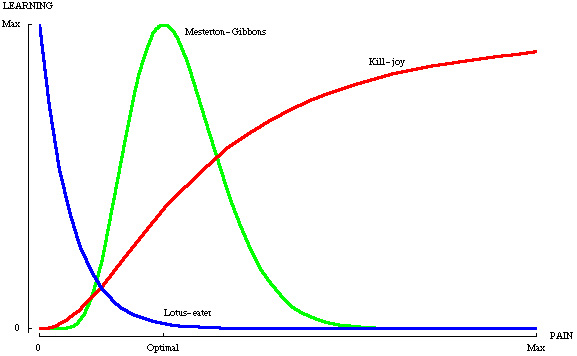
| My philosophy of learning is perhaps best expressed by the green curve in the diagram below: | |
ALTERNATIVE THEORIES OF LEARNING VERSUS PAIN
 | I don't know who you are (for the most part), but because everything works so much better when I do, I would like to learn your name as soon as possible. So, please take a sheet of card stock (or even paper), fold it in half, write your name in large letters on one side and stand it up on your desk so that I can see it. (Write what you want me to call you: if you're a William who likes to be called Dubya or a Margaret Jane who likes to be called Dee Dee, write Dubya or Dee Dee, not William or Margaret Jane.) Please bring your nameplate to every class until I have finally learnt your name (which will take significantly longer than it used to take when I started out) |
- Exercises on the current topic or topics
- An assigned reading, typically on the next topic(s), hence typically the next section or two of the text
- A problem or problems associated with the assigned reading
Typically, we will begin class by reviewing up to three different solution attempts that you have written on the board. A lecture will often follow. Early in the semester, that lecture will tend to be very brief. Its purpose will be to highlight the key points of an assigned reading, largely to jog your memory of reading it earlier, perhaps also partly to add some fresh perspective—but in any event based on the assumption that you have actually read it. As the semester progresses, however, lectures are likely to lengthen, because I will introduce material not covered by the text. Either way, I will work from notes that get posted here as soon after class as I can manage.
We will then proceed to work on problems, beginning with Item 3 if there exists an Item 3. Note the use of we—interactive problem solving implies working together, and in this class your active participation is vital. To encourage you in that regard, 15% of your final grade will be based on the extent to which you have participated in class.
In particular, on any given class day, up to three of you can earn 3% of your grade by writing a sufficient attempt at a homework problem on the board immediately before class. You must clear your choice of problem beforehand with me. I will then notify the class that the problem is taken, and up to two more of you can pick a different problem. The rest of you will have to wait for a later class. There are 37 non-test periods after the first, yielding capacity for 111 sufficient attempts; the enrollment is 22 and 5 x 22 = 110 < 111, so all of you in principle can earn all your participation points this way. But you can also earn them in class in other ways—by asking very good questions, by exemplary contributions to interactive problem solving, etc., etc. (where "etc., etc." just means whatever other ways I might have overlooked).
Questions may be asked at any time—and should be, if there's anything you don't understand. (Perhaps you have a question about the assigned reading that you anticipate being answered by one or more of the problems we work together; in which case, it may well be socially minded not to ask your question at the outset. However, if it turns out that you anticipated incorrectly, then be sure to ask your question before the class is over!)
Precise cut-off points for A, B and C will be determined by the distribution of grades at the end of the semester, but are likely be in the vicinity of 90%, 80% and 70%, respectively. In borderline cases, a smaller number of perfect answers will carry more weight than a proportionate number of imperfect answers (e.g., a ten and a zero will trump two fives); later scores will carry more weight than earlier scores; and—above all—an exemplary record of class participation will carry far more weight than a mediocre one. Plus or minus grades may be assigned in a manner consistent with standard University practice.
A score for a question worth 10 points should be interpreted as follows:
| 10 | Practically perfect |
| 9 | Still very good, but lacking—or wrong about—a significant detail |
| 8 | Still good, but lacking—or wrong about—significant details |
| 7 | Minimally satisfactory. You have—just—managed to demonstrate that you basically understand and are at least capable of getting all details correct (although it clearly did not happen this time) |
| 6 | A grade that will not be given |
| 5 | Half right in some appropriate sense (e.g., there were two parts, each worth 5 points, and your first part was practically perfect) |
| 1-4 | Not even half right and showing little understanding, but some degree of positive effort |
| 0 | Zero effort, or submitted in pencil |
You are also bound by the ordinary rules and customs of polite behavior that prevail in a civilized society. I assume that you know these rules and customs, and I expect you to comply with them. (In particular, you are not allowed to use a cell phone or otherwise have private conversations with others during class; and you are not allowed to create disturbances through arriving late or leaving early.)
Monday, February 22
Monday, March 28
Monday, April 11
Note, however, the following. First, you must identify yourself (i.e., you remain anonymous to the other students in the class, but not to me) in the body of your message (because typically your username does not identify you to me): I don't reply to anonymous email. Second, you should be as specific as possible in describing your difficulty: the more precisely you identify how you got stuck, the more helpful my reply is likely to be.
University Attendance Policy:
Excused absences include documented illness, deaths in the family and other documented crises, call to active military duty or jury duty, religious holy days, and official University activities. These absences will be accommodated in a way that does not arbitrarily penalize students who have a valid excuse. Consideration will also be given to students whose dependent children experience serious illness.
Academic Honor Policy:
The Florida State University Academic Honor Policy outlines the University's expectations for the integrity of students' academic work, the procedures for resolving alleged violations of those expectations, and the rights and responsibilities of students and faculty members throughout the process. Students are responsible for reading the Academic Honor Policy and for living up to their pledge to ". . . be honest and truthful and . . . [to] strive for personal and institutional integrity at Florida State University.'' (Florida State University Academic Honor Policy, found at http://dof.fsu.edu/honorpolicy.htm.)
Americans With Disabilities Act:
Students with disabilities needing academic accommodation should:
(1) register with and provide documentation to the Student Disability Resource Center; and
(2) bring a letter to the instructor indicating the need for accommodation and what type. This should be done during the first week of class.
This syllabus and other class materials are available in alternative format upon request.
For more information about services available to FSU students with disabilities, contact the:
Student Disability Resource Center
874 Traditions Way
108 Student Services Building
Florida State University
Tallahassee, FL 32306-4167
(850) 644-9566 (voice)
(850) 644-8504 (TDD)
sdrc@admin.fsu.edu
http://www.disabilitycenter.fsu.edu/
On-campus tutoring and writing assistance is available for many courses at Florida State University. For more information, visit the Academic Center for Excellence (ACE) Tutoring Services' comprehensive list of on-campus tutoring options—see http://ace.fsu.edu/tutoring or contact tutor@fsu.edu. High-quality tutoring is available by appointment and on a walk-in basis. These services are offered by tutors trained to encourage the highest level of individual academic success while upholding personal academic integrity.
"Except for changes that substantially affect implementation of the evaluation (grading) statement, this syllabus is a guide for the course and is subject to change with advance notice.''
Lecture Notes and Problems
- Basic logic: the propositional calculus (§§1.1-1.6, Wednesday, January 06)
- Basic logic: the predicate calculus (§1.7, Friday, January 08)
- Some methods of proof (§§2.2-2.3, 2.5.1-2.5.2, Monday, January 11)
- Proof by induction (§2.4, Wednesday, January 13)
- Set theory (§§3.1-3.5, Wednesday, January 20 and Friday, January 22)
- On counterexamples (Friday, January 22)
- Relations, especially equivalence relations (§4.1, Monday, January 25)
- Order relations (§4.2, Wednesday, February 3)
- Functions and compositions of functions (§§4.3-4.4, Friday, February 5 and Monday, February 8)
- More on relations, especially inverse functions (§4.4, Wednesday, February 10)
- Set cardinality (§4.5, Friday, February 12)
- More on set cardinality (§4.5, Monday, February 15)
- Well ordering and further set cardinality (§4.2, §4.5, Wednesday, February 24)
- More on proof by induction (§2.4, Monday, February 29)
- The integers (§6.2, Wednesday, March 02)
- ℤ and other algebraic structures (§6.2, Friday, March 04)
- ℤ and other rings (§§6.2-6.3, Friday, March 04 and Monday, March 14)
- More on rings, especially ℤ n (§§6.2-6.3, Monday, March 14)
- Further properties of rings (§6.3, Friday, March 18)
- Yet more on rings and fields, including ℚ (§6.3, Monday, March 21 and Wednesday, March 23)
- Ordered fields (§6.3, Wednesday, March 30 and Friday, April 01)
- Constructing ℝ from ℚ (§6.4, Friday, April 01 and Monday, April 04)
- ℝ: a complete ordered field (§6.4, Wednesday, April 13 to Wednesday, April 20)
- Yet more on set cardinality (§4.5)
- The Schröder-Bernstein theorem (§4.5)
- Even more on set cardinality (§4.5)
Solutions or Hints for Selected Problems
- Problem 1.1
- Problem 2.1
- Solution 3.1 Problem 3.8(b) Problem 3.09 Problem 3.10 Problem 3.11 Problem 3.12
- Problem 4.1 Problem 4.3 Problem 4.4 Problem 4.10
- Problem 5.2 Problem 5.3
- Problem 6.1
- Problem 7.2 Problem 7.4 Problem 7.5 Problem 7.6
- Problem 8.2 Problem 8.4 Problem 8.5 Problem 8.6
- Problem 9.2 Problem 9.3 Problem 9.7 Problem 9.8 Problem 9.9 Problem 9.10 Problem 9.11 Problem 9.12
- Problem 10.1 Problem 10.2 Problem 10.3 Problem 10.4 Problem 10.5 Problem 10.6 Problem 10.7 Problem 10.8 Problem 10.9 Problem 10.10 Problem 10.11 Problem 10.12
- Problem 11.1 Problem 11.2 Problem 11.3 Problem 11.4 Problem 11.5
- Problem 12.1 Problem 12.2 Problem 12.3
- Problem 13.1 Problem 13.2 Problem 13.3 Problem 13.4 Problem 13.5 Problem 13.6 Problem 13.7
- Problem 14.2 Problem 14.3 Problem 14.4 Problem 14.5 Problem 14.6 Problem 14.7 Problem 14.8 Problem 14.9
- Problem 15.1 Problem 15.2
- Problem 17.2 Problem 17.3
- Problem 18.2 Problem 18.3 Problem 18.4 Problem 18.5 Problem 18.6 Problem 18.7 Problem 18.8 Problem 18.9 Problem 18.10 Problem 18.11 Problem 18.12 Problem 18.13
- Problem 19.1 Problem 19.2 Problem 19.3
- Problem 20.1 Problem 20.2 Problem 20.3
- Problem 22.1 Problem 22.2 Problem 22.3 Problem 22.4
- Problem 23.1 Problem 23.2 Problem 23.3 Problem 23.4 Problem 23.5 Problem 23.6 Problem 23.7
- Problem 24.1 Problem 24.2 Problem 24.3 Problem 24.4 Problem 24.5
- Problem 26.1 Problem 26.2 Problem 26.3
Answers For Exercises In Elements Of Advanced Mathematics
Source: https://www.math.fsu.edu/~mesterto/MGF3301.html
Posted by: baileysaisards.blogspot.com
0 Response to "Answers For Exercises In Elements Of Advanced Mathematics"
Post a Comment